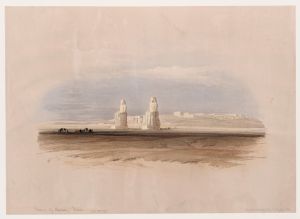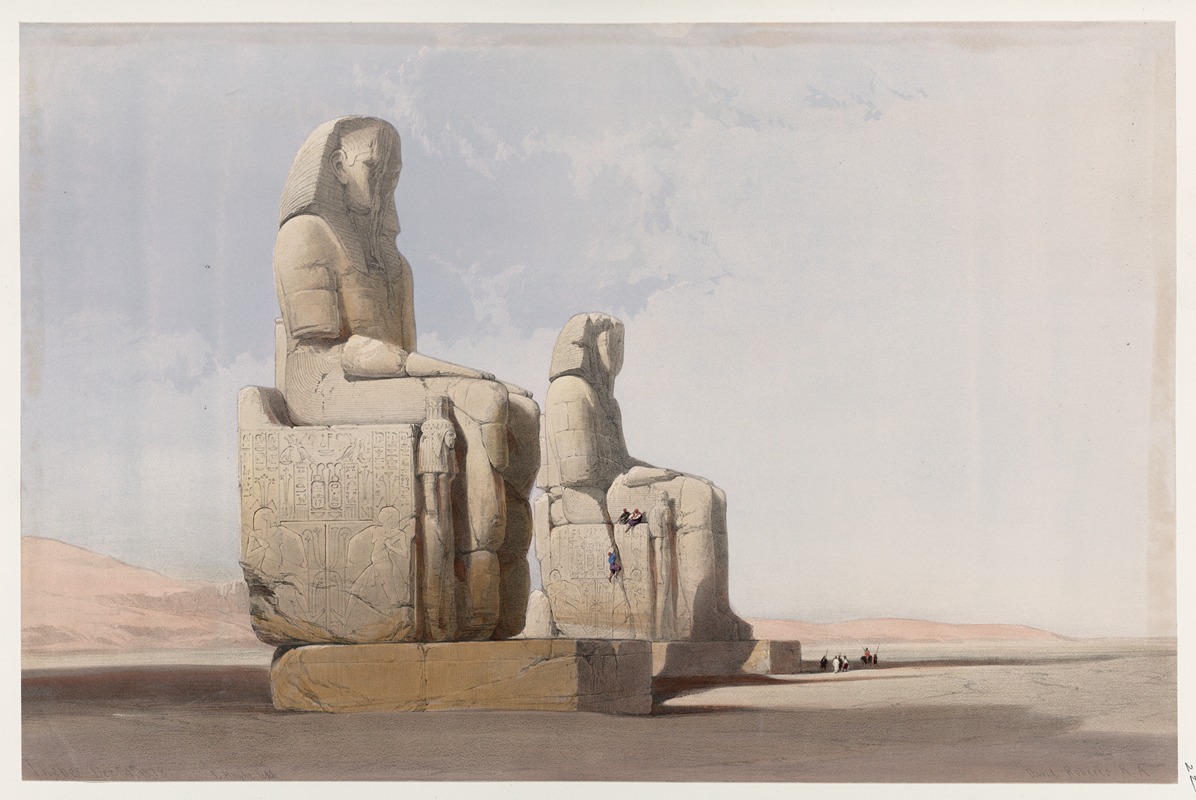
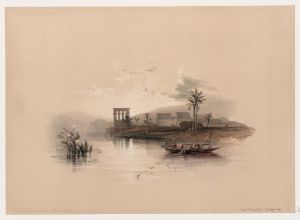
Thebes. Dec. 4th, 1838.
A hand-painted replica of David Roberts’s masterpiece Thebes. Dec. 4th, 1838., meticulously crafted by professional artists to capture the true essence of the original. Each piece is created with museum-quality canvas and rare mineral pigments, carefully painted by experienced artists with delicate brushstrokes and rich, layered colors to perfectly recreate the texture of the original artwork. Unlike machine-printed reproductions, this hand-painted version brings the painting to life, infused with the artist’s emotions and skill in every stroke. Whether for personal collection or home decoration, it instantly elevates the artistic atmosphere of any space.
David Roberts was a Scottish painter known for his detailed and accurate depictions of architectural and historical sites. One of his notable works is "Thebes. Dec. 4th, 1838." This painting is part of a larger collection of lithographs that Roberts produced following his travels to the Middle East and North Africa between 1838 and 1839. These works were later published in a series titled "The Holy Land, Syria, Idumea, Arabia, Egypt, and Nubia," which gained significant acclaim for their artistic and documentary value.
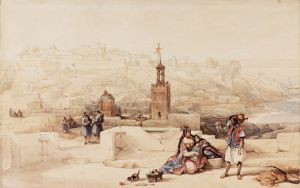
"Thebes. Dec. 4th, 1838" captures the ancient city of Thebes, located in present-day Luxor, Egypt. Thebes was a prominent city in ancient Egypt, serving as a religious and political hub, particularly during the New Kingdom period. It is renowned for its archaeological significance, including monumental sites such as the Karnak Temple Complex and the Valley of the Kings.
Roberts' painting reflects his keen interest in the architectural grandeur and historical importance of Thebes. His work is characterized by meticulous attention to detail, capturing the essence of the ruins and the surrounding landscape. The painting likely depicts the remnants of Thebes' once-majestic structures, offering a glimpse into the city's past glory.
Roberts embarked on his journey to the Middle East in 1838, motivated by a desire to document the region's historical and biblical sites. He traveled extensively, visiting Egypt, the Sinai Peninsula, and the Levant. During his travels, Roberts made numerous sketches and notes, which he later used to create his lithographs. His works are celebrated for their accuracy and artistic quality, providing valuable insights into the 19th-century Western perception of the Middle East.
The lithographs were produced with the assistance of Louis Haghe, a skilled lithographer, who helped translate Roberts' sketches into detailed prints. The collaboration between Roberts and Haghe was instrumental in the success of the published series, which was well-received by both the public and critics.
Roberts' depiction of Thebes, along with his other works, played a significant role in shaping Western understanding and appreciation of Middle Eastern and North African cultures and histories. His paintings and lithographs were among the first to provide a comprehensive visual record of these regions, contributing to the field of Orientalism in art.
"Thebes. Dec. 4th, 1838" remains an important piece within Roberts' oeuvre, exemplifying his skill in capturing the majesty and mystery of ancient sites. His work continues to be studied and admired for its historical significance and artistic merit, offering a window into the past and the enduring allure of ancient civilizations.



![Entrance to the tombs of the kings of Thebes. Bab-el-Malouk [Bîbân al-Mulûk].](/imgs/217479/s/david-roberts-entrance-to-the-tombs-of-the-kings-of-thebes-babelmalouk-biban-almuluk-599b8a4c.jpg)
![One of two colossal statues of Rameses [sic] II. Entrance to the Temple at Luxor.](/imgs/217522/s/david-roberts-one-of-two-colossal-statues-of-rameses-sic-ii-entrance-to-the-temple-at-luxor-473c42e1.jpg)