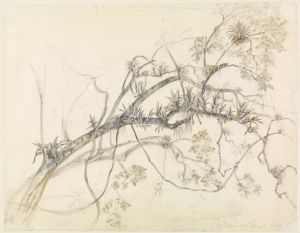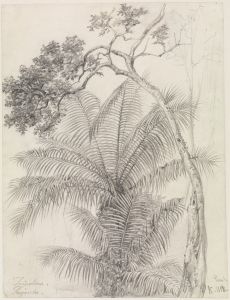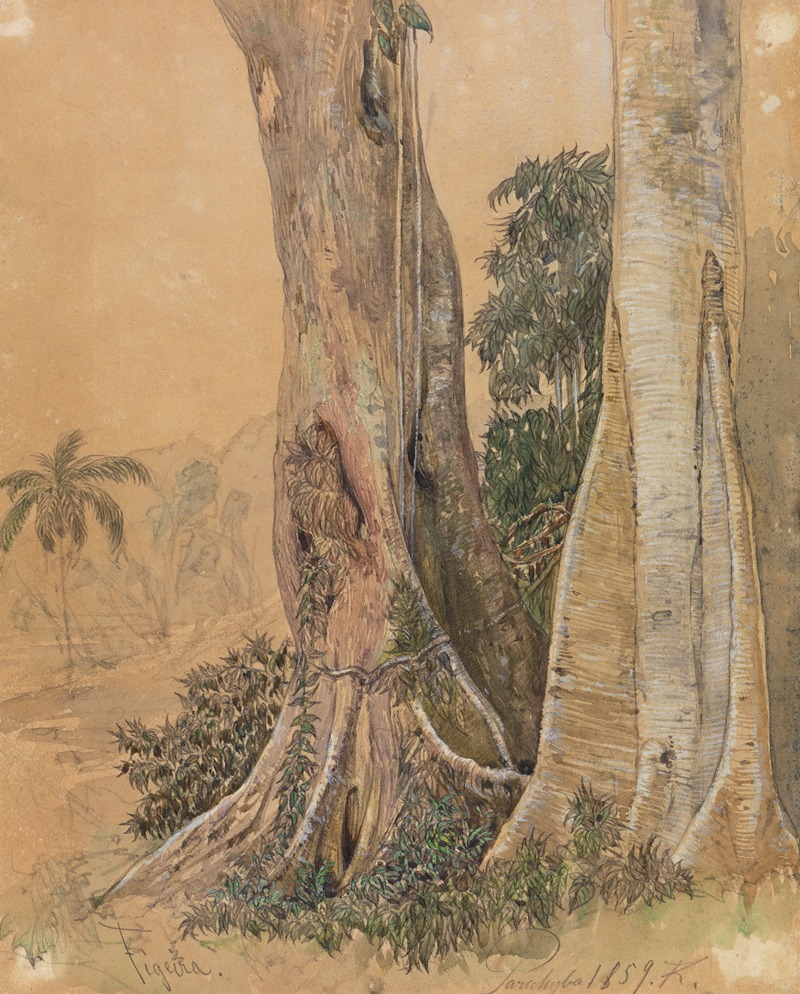
Figeira-Stämme am Ufer des Parahyba
A hand-painted replica of Ferdinand Keller’s masterpiece Figeira-Stämme am Ufer des Parahyba, meticulously crafted by professional artists to capture the true essence of the original. Each piece is created with museum-quality canvas and rare mineral pigments, carefully painted by experienced artists with delicate brushstrokes and rich, layered colors to perfectly recreate the texture of the original artwork. Unlike machine-printed reproductions, this hand-painted version brings the painting to life, infused with the artist’s emotions and skill in every stroke. Whether for personal collection or home decoration, it instantly elevates the artistic atmosphere of any space.
Figeira-Stämme am Ufer des Parahyba (translated as "Fig Trees on the Banks of the Paraíba") is a painting by the German artist Ferdinand Keller (1842–1922). Keller was a prominent painter of the 19th century, known for his works that often depicted historical, mythological, and exotic themes. He was born in Karlsruhe, Germany, and studied at the Karlsruhe Academy of Fine Arts, later becoming its director.
The painting, created in 1883, showcases Keller's interest in exotic landscapes and his ability to capture the lushness of tropical environments. It depicts a serene scene along the banks of the Paraíba River, which is located in Brazil. The focus of the painting is on the fig trees (Figeira in Portuguese), which dominate the composition with their intricate branches and dense foliage. The riverbank is portrayed with meticulous detail, emphasizing the natural beauty of the region.
Keller's depiction of the Brazilian landscape reflects the influence of the 19th-century European fascination with exotic and distant lands. This interest was fueled by increased global exploration and the dissemination of travel literature and scientific studies. Although Keller himself never traveled to Brazil, his work was likely inspired by written accounts, illustrations, and possibly photographs of the region, which were becoming more widely available during his time.
The painting is notable for its atmospheric quality, achieved through Keller's use of light and shadow to create depth and texture. The interplay of sunlight filtering through the trees and reflecting on the water adds a sense of realism and tranquility to the scene. The work is also an example of Keller's skill in combining detailed observation with a romanticized vision of nature.
Figeira-Stämme am Ufer des Parahyba is part of the collection of the Staatliche Kunsthalle Karlsruhe in Germany, where it remains an important example of Keller's oeuvre. The painting is appreciated for its artistic merit as well as its representation of 19th-century European perspectives on the natural world.
No further specific historical or contextual details about the painting are widely documented.






![Rejoice, Carnival, for Tomorrow Thou Wilt Be Ashes [Carnival Folly]](/imgs/264649/s/francisco-de-goya-rejoice-carnival-for-tomorrow-thou-wilt-be-ashes-carnival-folly-5d37f315.jpg)