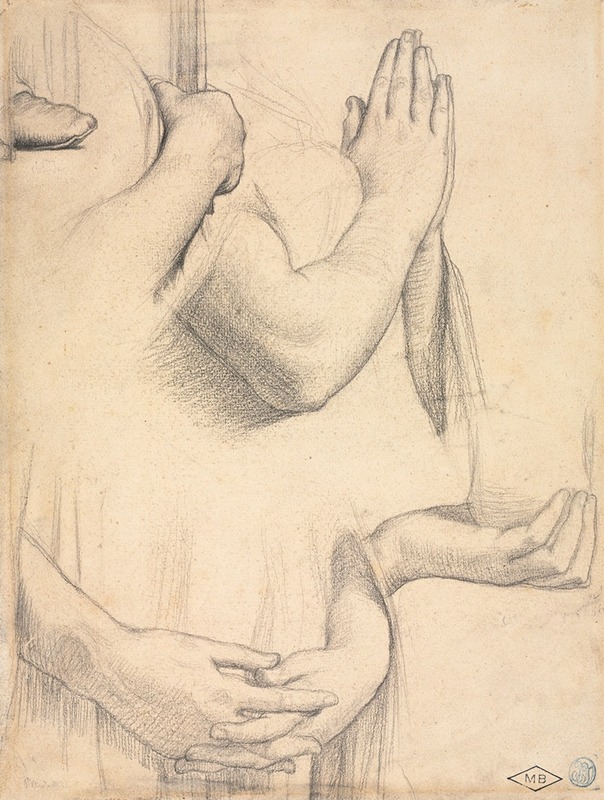
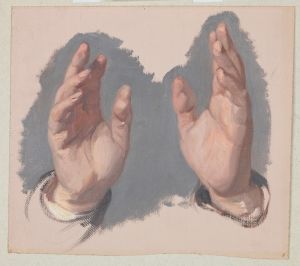
Study of Hands
A hand-painted replica of Jean Auguste Dominique Ingres’s masterpiece Study of Hands, meticulously crafted by professional artists to capture the true essence of the original. Each piece is created with museum-quality canvas and rare mineral pigments, carefully painted by experienced artists with delicate brushstrokes and rich, layered colors to perfectly recreate the texture of the original artwork. Unlike machine-printed reproductions, this hand-painted version brings the painting to life, infused with the artist’s emotions and skill in every stroke. Whether for personal collection or home decoration, it instantly elevates the artistic atmosphere of any space.
Jean Auguste Dominique Ingres, a prominent French Neoclassical painter, is renowned for his precise draftsmanship and his ability to convey texture and form through his art. Among his many works, "Study of Hands" is a notable piece that exemplifies his skill in capturing the human form with meticulous attention to detail. Although specific details about this particular study are limited, it is reflective of Ingres' broader artistic practice and his dedication to the study of anatomy and form.
Ingres was born in 1780 in Montauban, France, and showed an early aptitude for art. He studied under Jacques-Louis David, a leading figure of the Neoclassical movement, which greatly influenced his style. Ingres' work is characterized by his commitment to line and form, often prioritizing these elements over color and light, which were more emphasized by his Romantic contemporaries.
"Study of Hands" is an example of Ingres' preparatory work, which he often undertook to perfect his compositions. Hands, being one of the most expressive parts of the human body, were a frequent subject of study for Ingres. His studies of hands reveal his understanding of anatomy and his ability to convey subtle gestures and emotions through the positioning and rendering of fingers and palms. These studies were not only exercises in anatomy but also served as foundational elements for his larger compositions.
Ingres' approach to drawing was methodical and precise. He believed that drawing was the foundation of all visual art and often stated that "drawing is the probity of art." His studies, including those of hands, were executed with a focus on clarity and accuracy, often using graphite or pencil on paper. These studies allowed him to explore the nuances of form and movement, which he would later incorporate into his paintings.
Throughout his career, Ingres produced numerous portraits and historical scenes, many of which included detailed depictions of hands. His ability to render hands with such precision contributed to the overall expressiveness and realism of his figures. Ingres' portraits, such as "Portrait of Madame Moitessier" and "Portrait of Comtesse d'Haussonville," showcase his skill in depicting hands, often using them to convey the personality and status of his subjects.
While "Study of Hands" may not be as widely recognized as some of his completed paintings, it is an important example of Ingres' dedication to his craft. These studies were integral to his artistic process, allowing him to refine his technique and deepen his understanding of the human form. Ingres' legacy as a master draftsman is evident in these works, which continue to be studied and admired for their technical proficiency and artistic insight.
In conclusion, "Study of Hands" by Jean Auguste Dominique Ingres is a testament to the artist's commitment to the study of form and his exceptional skill in drawing. Although specific details about this particular study are scarce, it remains an important part of Ingres' oeuvre, reflecting his dedication to the principles of Neoclassicism and his enduring influence on the art world.






![Detail of Drapery [Crayon study no. 5.14]](/imgs/263799/s/john-singer-sargent-detail-of-drapery-crayon-study-no-514-11654866.jpg)