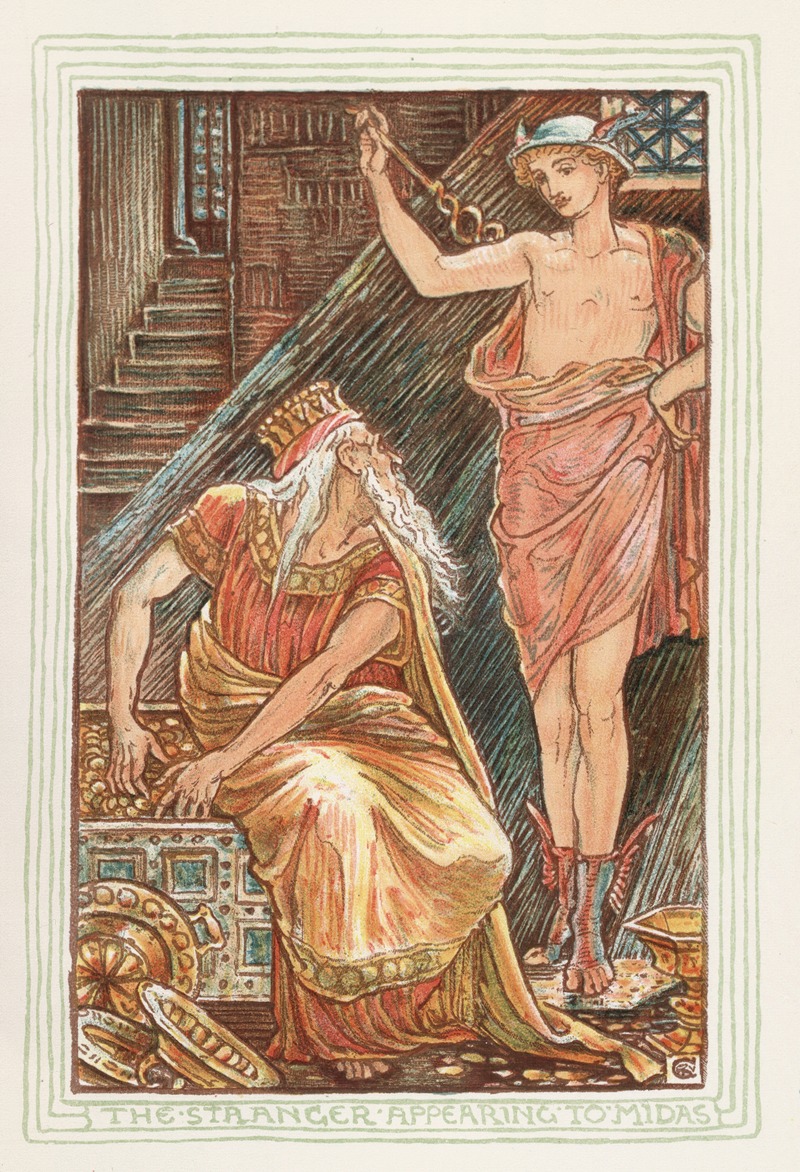
The Stranger Appearing to Midas
A hand-painted replica of Walter Crane’s masterpiece The Stranger Appearing to Midas, meticulously crafted by professional artists to capture the true essence of the original. Each piece is created with museum-quality canvas and rare mineral pigments, carefully painted by experienced artists with delicate brushstrokes and rich, layered colors to perfectly recreate the texture of the original artwork. Unlike machine-printed reproductions, this hand-painted version brings the painting to life, infused with the artist’s emotions and skill in every stroke. Whether for personal collection or home decoration, it instantly elevates the artistic atmosphere of any space.
"The Stranger Appearing to Midas" is a painting by the English artist Walter Crane, who was a prominent figure in the Arts and Crafts Movement during the late 19th and early 20th centuries. Walter Crane was known for his illustrations, paintings, and designs that often drew upon classical mythology, fairy tales, and literature.
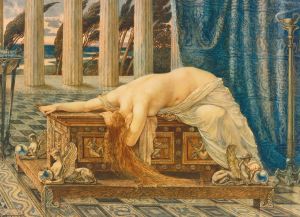
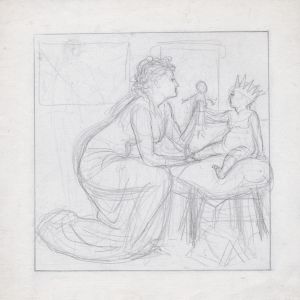
This particular painting, "The Stranger Appearing to Midas," depicts a scene from the ancient Greek myth of King Midas. According to the myth, Midas was a king who was granted a wish by the god Dionysus. Midas wished that everything he touched would turn to gold, a wish that soon proved to be a curse rather than a blessing. The painting captures the moment when a stranger, who is actually the god Dionysus in disguise, appears before Midas.
Walter Crane's interpretation of this mythological scene is characterized by his distinctive style, which combines elements of Pre-Raphaelite art with his own unique approach to composition and color. The painting likely features rich, vibrant colors and intricate details, which are hallmarks of Crane's work. His use of symbolism and allegory would have been intended to convey deeper meanings and moral lessons, in keeping with the themes of the original myth.
Crane's work often reflected his interest in social and political issues, and he was an advocate for the improvement of working conditions and the promotion of the arts as a means of enriching society. His involvement in the Arts and Crafts Movement was driven by a belief in the value of craftsmanship and the importance of beauty in everyday life.
"The Stranger Appearing to Midas" would have been created during a period when Crane was producing some of his most significant works, both as an illustrator and a painter. His contributions to the visual arts extended beyond painting, as he also designed wallpapers, textiles, and other decorative arts, all of which were influenced by his commitment to the principles of the Arts and Crafts Movement.
While specific details about the painting's dimensions, medium, and current location are not provided here, it is clear that "The Stranger Appearing to Midas" is an example of Walter Crane's ability to bring mythological and literary subjects to life through his art. His work continues to be celebrated for its beauty, craftsmanship, and the way it reflects the ideals of the movement he helped to shape.
In summary, "The Stranger Appearing to Midas" by Walter Crane is a painting that illustrates a moment from Greek mythology with the artist's characteristic style and attention to detail. It embodies the themes and values of the Arts and Crafts Movement, of which Crane was a leading figure.