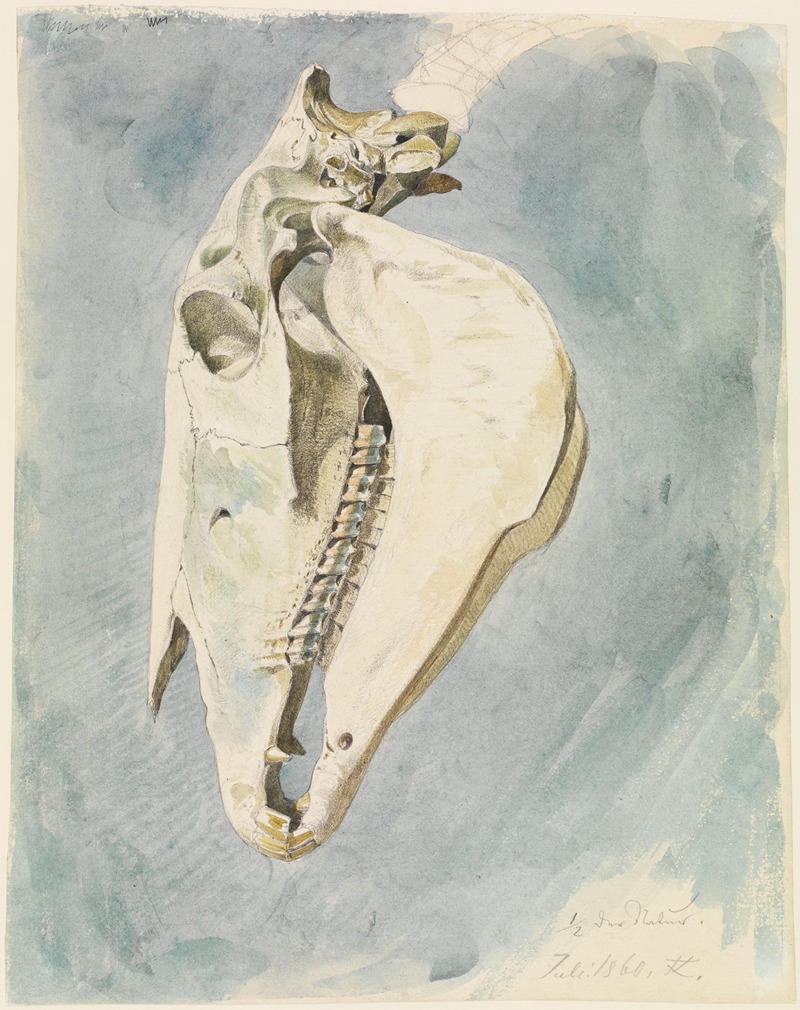
Studie eines Tierschädels
A hand-painted replica of Ferdinand Keller’s masterpiece Studie eines Tierschädels, meticulously crafted by professional artists to capture the true essence of the original. Each piece is created with museum-quality canvas and rare mineral pigments, carefully painted by experienced artists with delicate brushstrokes and rich, layered colors to perfectly recreate the texture of the original artwork. Unlike machine-printed reproductions, this hand-painted version brings the painting to life, infused with the artist’s emotions and skill in every stroke. Whether for personal collection or home decoration, it instantly elevates the artistic atmosphere of any space.
Ferdinand Keller was a notable Swiss painter born on August 5, 1842, in Lausanne, Switzerland, and he passed away on July 8, 1922, in Baden-Baden, Germany. He is recognized for his contributions to the art world during the 19th and early 20th centuries. Keller's works often encompassed historical and mythological themes, and he was known for his detailed and realistic style.
One of Keller's lesser-known works is "Studie eines Tierschädels," which translates to "Study of an Animal Skull." This painting exemplifies Keller's skill in rendering detailed and realistic depictions of his subjects. The artwork focuses on the anatomical study of an animal skull, showcasing Keller's interest in natural history and his ability to capture the intricacies of bone structure.
"Studie eines Tierschädels" is a testament to Keller's meticulous approach to painting. The artwork likely served as a study piece, allowing Keller to explore the form and structure of the skull in great detail. Such studies were common among artists of the time, who often used them to hone their skills and deepen their understanding of anatomy and natural forms.
The painting features a single animal skull, rendered with precise attention to detail. The skull is depicted against a neutral background, which helps to emphasize its form and structure. Keller's use of light and shadow adds depth and dimension to the skull, highlighting its contours and the intricate details of its surface. The overall composition is simple yet effective, drawing the viewer's attention to the subject matter.
While "Studie eines Tierschädels" may not be as widely recognized as some of Keller's other works, it is an important example of his artistic process and his dedication to studying and understanding the natural world. The painting reflects the broader 19th-century interest in natural history and the scientific study of anatomy, which influenced many artists of the period.
Ferdinand Keller's contributions to art extend beyond his individual works. He was also an influential teacher and mentor to many young artists. His legacy includes not only his paintings but also his impact on the development of art education in Switzerland and Germany. Keller's works are held in various collections, and his influence can be seen in the works of his students and contemporaries.
In summary, "Studie eines Tierschädels" by Ferdinand Keller is a detailed and realistic study of an animal skull, showcasing the artist's skill and interest in natural history. The painting serves as an example of Keller's meticulous approach to art and his dedication to understanding the intricacies of his subjects. While it may not be as famous as some of his other works, it remains an important piece within his oeuvre, reflecting the broader artistic and scientific interests of the 19th century.